

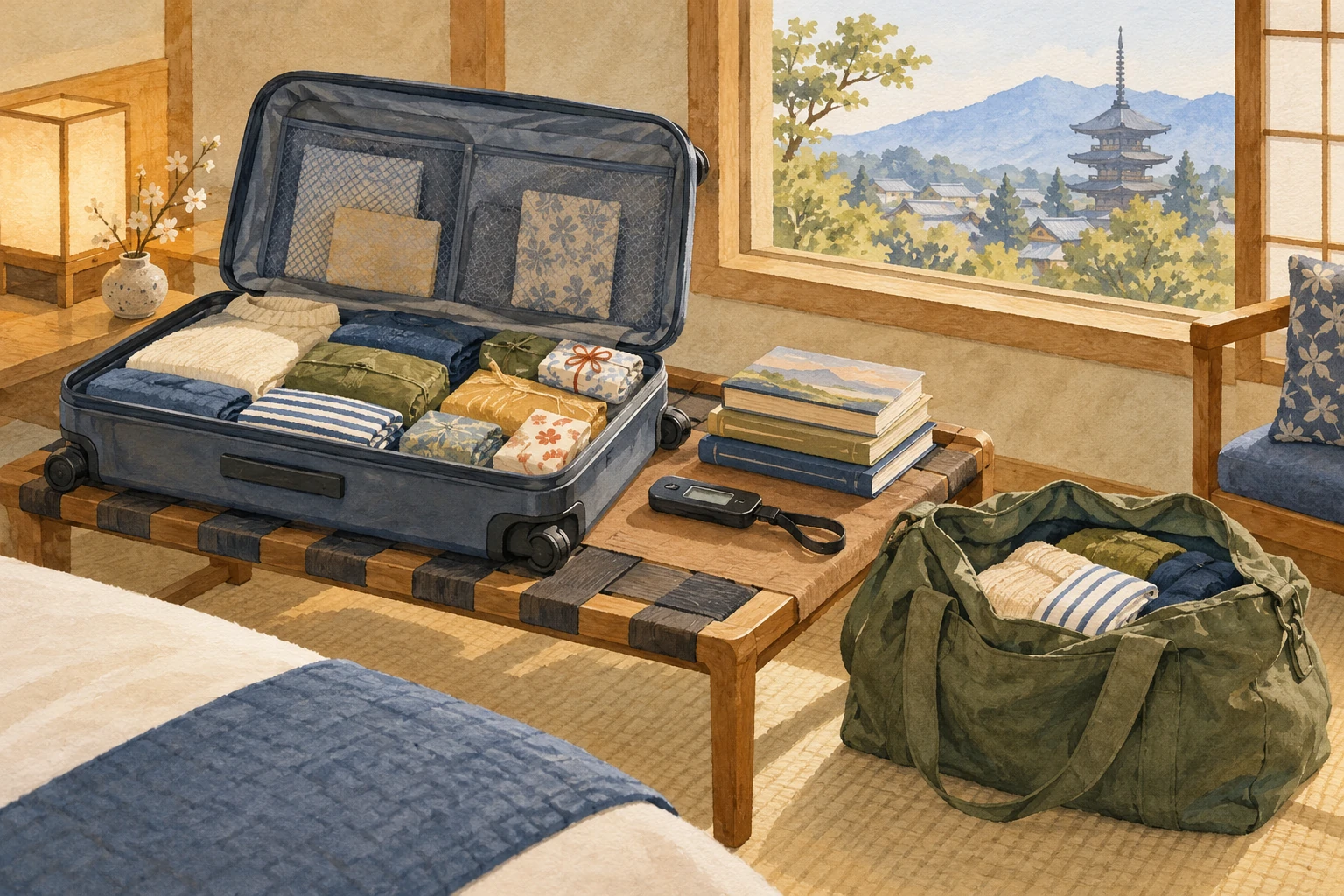
You arrived in Japan with space to spare. Now there are clothes, books and carefully wrapped souvenirs on the hotel bed, and your suitcase will no longer close comfortably.
A foldable duffel is worth considering when the overflow is mostly soft, light items. An additional suitcase can be more practical when you need wheels or space for individually protected purchases. Before buying either, check what your flight allows and decide which belongings can move between bags. More capacity alone will not solve an overweight bag.
A foldable duffel is a soft bag that packs down when empty; a suitcase gives you a structured container, often with wheels. They solve different packing and carrying problems. The useful first question is whether you have run out of space, exceeded a weight limit, or simply created a load you cannot comfortably move.
This guide is for visitors taking purchases home from Japan. It compares packing options, not specific products, and does not claim hands-on testing. Official information was checked on October 11, 2026.
Contents
1. Start with your return ticket
Checked baggage is handed to the airline, travels in the aircraft hold and is collected after arrival. Carry-on baggage travels with you in the passenger cabin. Neither the material nor the shop label decides which category a bag belongs in: a suitcase can be a carry-on, and a soft bag may be checked if it meets the applicable requirements. Each category has its own limits.
Open your booking and write down four things: checked-bag allowance, weight per bag or total allowance, permitted dimensions, and the cost of an additional bag. Check the cabin allowance separately, including personal items. Connecting flights and separately booked tickets deserve their own check.
ANA, for example, says checked allowances vary with fare rules and that the allowance on the ticket applies. Other airlines' rules may apply on mixed-airline itineraries. Use the airline's page as a starting point, then verify your booking. ANA checked baggage
Your allowance is the baggage included with your ticket. Read whether it is expressed as a number of pieces with a limit per piece, or as a total weight. A per-bag limit cannot simply be pooled across two bags.
For a hypothetical ticket allowing two checked bags of up to 23 kg each, a 30 kg bag plus a 10 kg bag still has one overweight piece. Repacking them to 20 kg each would meet that weight condition, but dimensions and contents would still need checking. These numbers illustrate the calculation, not a universal allowance. Weigh the container and its contents together.
“Carry-on size” on a shop label is not approval for every flight. ANA's published cabin rules, for example, count the carry-on and personal item together for weight and include handles and wheels in dimensions. Check your operating airline's own requirements. ANA carry-on rules
2. Sort the purchases before choosing the bag
Make three groups on the bed:
- Soft, fairly light items: clothing, towels and similar purchases.
- Dense items: books and other things that add weight quickly.
- Items needing individual protection or special handling: ceramics, bottles, electronics and valuables.
Then try moving ordinary clothes out of your original suitcase. That may create protected space for purchases while a second bag carries the clothes. Keep essential travel documents, valuables and items subject to cabin-only rules accessible.
Weigh the original bag after repacking. A second container helps only if the resulting arrangement fits the allowances you actually have or are prepared to purchase.
3. When a foldable duffel makes sense
A foldable bag is useful when you want spare capacity without carrying another rigid case throughout Japan. Compare its empty weight, folded dimensions, full dimensions and stated load limit. A generous capacity in litres tells you little about whether the packed bag meets airline limits.
Litres describe storage volume. A manufacturer's load limit describes how much weight the bag is intended to carry. Your airline allowance describes what your ticket permits. Clothing may fill a bag before it becomes heavy; books can add substantial weight in a small space. Work out which of these limits is causing your problem before choosing a bigger bag.
Look closely at the zip, handle attachments and base. Can the bag close fully without stretching? Can you carry it comfortably when it contains the things you intend to move? A shoulder strap or luggage sleeve, which slides over a suitcase's extended handle, may help. Check compatibility and stability rather than assuming it will stay balanced on your suitcase.
Soft clothes are a straightforward starting point. A thin unstructured bag provides little separation between a fragile purchase and outside pressure. Do not treat a “travel bag” label as evidence that it is suitable for checked handling. Confirm the manufacturer's intended use and your carrier's acceptance requirements.
Measure it when packed: soft sides can bulge beyond the dimensions shown for the empty product.
4. When an additional suitcase earns its space
Consider another suitcase when carrying the extra weight by hand would be awkward, or when a structured container would make packing several protected items easier. Wheels can help on smooth routes, but they still leave you with another case to lift, store and manoeuvre.
Before paying, check the empty weight and outside dimensions, including wheels and handles. Inspect the closure, internal restraints and wheel movement. Leave space for padding around delicate items; a rigid shell alone is no guarantee against breakage. Check the airline's fragile-item advice and liability terms before deciding to check anything difficult to replace. ANA fragile-item guidance
Buying near the end of the trip avoids carrying the case between earlier destinations. It also leaves less time to find a suitable size and repack. Allow a shopping and packing window rather than relying on an unspecified airport shop being open or stocked.
The reason to buy another case is a specific job: rolling a load that would be awkward to carry, or arranging protected items inside a structured container. If you only need to move a few light clothes and want a small spare bag to store at home, a foldable duffel may fit your plans better. Compare the purchase price with any extra-baggage and delivery charges, rather than comparing bag prices alone.
Taking a smaller case inside a larger one from the start is another option. Weigh the nested pair before departure and remember that you will eventually need to handle both separately.
5. Check what cannot simply change bags
Cosmetics and food can complicate the cabin plan. Narita's international-flight guidance generally requires liquids in containers with a capacity of 100 ml or less, together in a transparent resealable bag of no more than one litre, limited to one bag per passenger. Gels and products such as miso can also count as liquids. Check exceptions and any transfer-airport restrictions before packing. Narita liquid restrictions
Power banks are a different issue. JAL prohibits them in checked baggage; capacity, quantity and onboard-use conditions must also be checked for your flight. If a cabin bag is taken for checking, remove items that cannot go in the hold. JAL restricted items
Keep restricted items, passports and valuables separate while you repack. Adjust weight using belongings that can actually change bags, rather than putting everything into whichever container has space.
6. Delivery and shipping solve different problems
Airport luggage delivery can reduce what you carry across Japan, but you still need an airline-compliant arrangement at departure. Yamato's standard Airport TA-Q-BIN guidance calls for sending bags two days before departure, or three in some areas, with counter-specific deadlines. Verify your terminal, collection hours and exact deadline before using it. Yamato Airport TA-Q-BIN
Sending purchases overseas is a separate option. Compare the shipping quote with the extra-baggage cost, and check whether the destination and contents are accepted, what paperwork is needed, and possible import charges. Do not assume everything accepted as airline baggage can be posted. Japan Post restrictions
Tax-free purchases need particular care. Japan Customs says the previous departure procedure based on proof of separately shipped tax-free goods ended on March 31, 2025. Do not assume posting purchases home preserves their tax-free treatment. Japan Customs
Here, “tax-free” means purchases made under Japan's consumption-tax exemption system for eligible visitors. It does not remove your destination country's import or declaration rules. Keep the Japanese departure procedure and the rules for bringing goods into your home country as two separate checks.
For purchases from November 1, 2026, Japan introduces a refund method following departure customs confirmation. Complete the procedure with all your tax-free purchases in your possession, before checking your bags. Earlier purchases also require customs confirmation before checking bags containing tax-free goods. Japan Tourism Agency: new method · Japan Customs: earlier guidance
A final packing decision
View the full diagram (new tab)
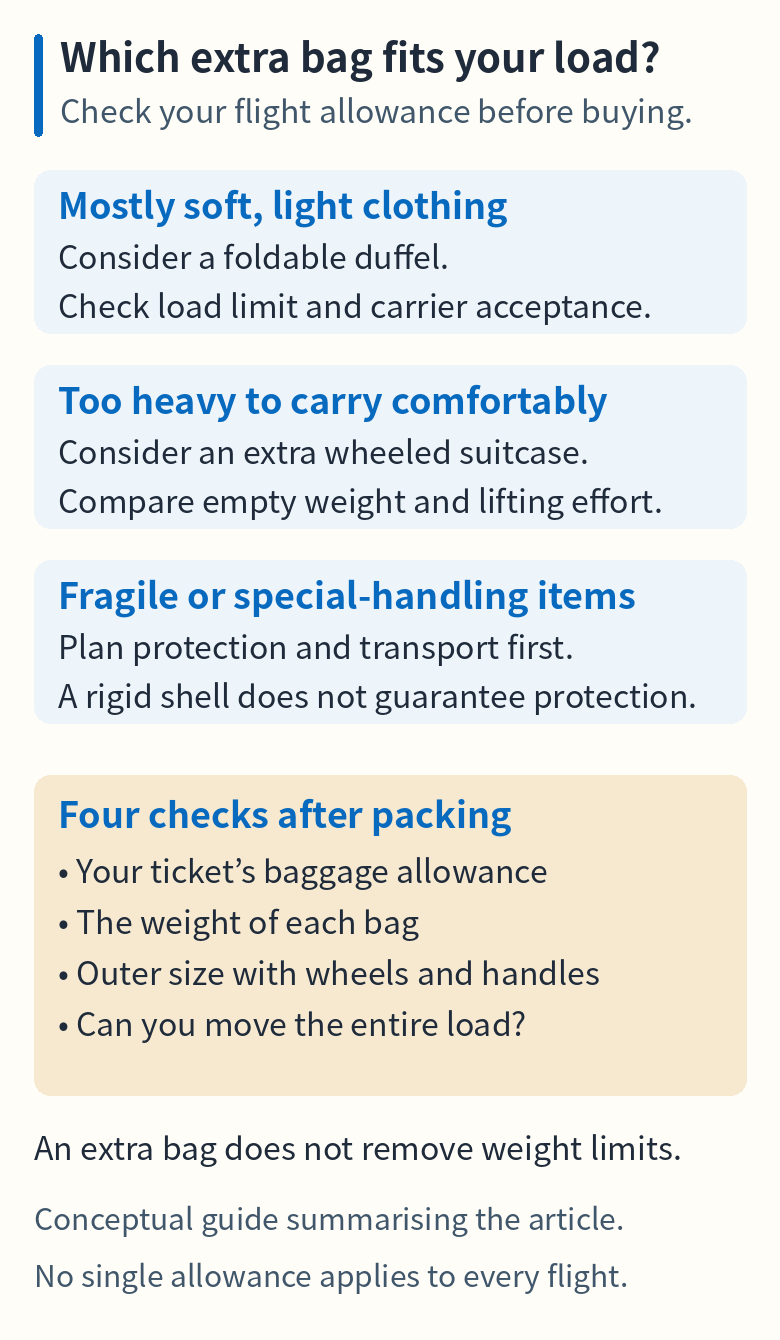
Choose the smallest workable arrangement after a trial pack. For mostly clothes, test a foldable bag. For a load you cannot comfortably carry, compare a wheeled case and delivery costs. For delicate purchases, settle the protection and transport plan before buying more capacity.
Finally, weigh and measure every packed bag, count your cabin items, and rehearse moving everything together. The useful question is: can you get this exact load from the hotel to home within your route's rules?